The Tourism Times | Breaking tourism-related news from Nepal and beyond
°C
T3 Special
Nepal: Tell me a story
Basantapur. Photo: Ness
By
Emili Kolk
Published at : 4 Jul 2025, 12:00 AM
I spend my last night in Kathmandu at a small, dimly lit local establishment. There’s a vacant table next to the entrance. I sit down, order a thukpa and a glass of milk tea, and slowly gaze around the room. A peculiar group of people stands out—hunched around an elderly foreign gentleman dressed in a shabby suit, with a pointed moustache and oval spectacles. The others listen to him intently, occasionally bursting into laughter. I lean in ever so slightly while I wait for my supper, and listen in on the conversation, learning that the man is a well-travelled writer, telling stories of his adventures here and abroad.
Captivatingly, he recounts the freeriders on the Trans-Siberian railway, the elegant yet unkempt ladies of Paris, the jarringly strong cigars of Italy, and the endless grey of America. He speaks of the brute sauna traditions of Constantinople, as well as the long, cold, dark winters of a faraway place he returns to for writing. I am enchanted as he paints such vivid pictures with mere words, enthralling the whole crowd.
As the night progresses, one by one, people begin to leave. Finally, the gentleman stands up, gathers his hat and belongings, and prepares to be on his way. I stop him with a gentle gesture, introduce myself, and ask if I may have a moment of his time—confessing to eavesdropping and thanking him for the incredible stories. I invite him to sit at my table, and so he does.
After a long pause, as if not knowing where to begin, he tells me he has just arrived in Kathmandu. Upon hearing that it’s my last night, he asks me about the local life and customs, and all the practical ins and outs. He listens absently for a while, then suddenly stops me mid-sentence with a mysterious smile on his face, hunches over the table, lowers his voice, and asks slowly: “Yes, yes, but what is Nepal as you know it?”
I pause, look into his earnest, childlike eyes and respond, “You wonder? I shall tell you a story then:”
All the roads in Nepal are winding and take you to unexpected places. I find myself standing in a ditch in the midday heat by an overwhelmingly chaotic street, trying to catch the right bus. The sun is ablaze, a few rugged dogs stoically cross the road, while scooters, cars, bikes, people, goats, cows, and trucks roll by in a never-ending symphony of dust clouds and loud horns.
A scooter approaches from behind, slows down, and I hear a voice from beneath the helmet: “Hello, madam, which country?” I can’t help but smile. Indeed—which country is this, where I find myself? So different from my own—mine being one of order, plans, efficiency, straight paved highways. Amid this chaos, wandering along this dirt road, I try to remember why I left the hotel in the first place and where I’m heading, trying not to get entangled in the low-hanging electrical wires. I glance behind me now and then to see if there’s another bus coming. Soon, I am to meet Him.
Him—a young man in his early twenties, swaying out of the open door of the bus, shouting out names of main stops along the route in a quick-paced, rhythmic, melodic manner. I think I catch the name of my destination and step forward, repeating what I thought I heard. He quickly tilts his head from one side to the other, slaps the body of the rusty old vehicle with an open palm—signaling the driver to stop—and I climb aboard. Two slaps, and the journey begins.
The dark, playful eyes of the boy reflect my own thoughts—why should a bus ride mean dozing off on a straight, boring highway when the journey could be so much more? You’re welcome—step aboard a real theme park ride! I look around in vain for a seat. No problem! Let’s make one! Like a magician, he pulls out a wooden slab and places it on metal pins jutting out from beneath the driver’s seat. Voilà, a seating arrangement. Fold your legs beneath you, straighten your soon-to-be-aching back, and enjoy the ride. Your baggage has already been thrown somewhere in the back of the bus.
Bright ribbons dangle from the ceiling, along with curtain drapes and tiny bells. The steering wheel is wrapped in neon yellow fabric with decorative strings, and the dashboard is filled with statues of numerous gods and flowers. After all, our safe arrival depends on them and them alone.
Without a doubt, the heart and soul of the bus is the young conductor. With a stack of rupees in one hand, he announces ticket fares—improvised numbers—while waving at people outside to hop aboard, even though by any conventional standard, the bus is already full to the brim. But the more, the merrier! His additional duty is to keep spirits high by shouting funny remarks and blasting traditional-style radio hits at a volume so loud there’s little mental space left to worry about the steep canyons beside the narrow, disintegrating dirt road. No need to check the map—we’re not far yet! The average road speed is 20 km/h, taking 10 hours to cross 200 kilometers.
Now and then, he glances at me in his cheerful manner, as if to say this is the best ride of my life.
Life passes by at an extraordinarily slow pace. Brown clay sheds with tea kettles on gas burners. Old men sitting in front of huts playing cards. Women washing laundry. Children playing on gravel piles. Dried-up riverbeds. In addition to millions of potholes that slow us down, we stop every thirty meters to let someone off or pick someone up.
By now, my legs have gone numb. I peer at my fellow travelers—some eating, a few dozing, others just staring out the window. Beautiful gold-embroidered saris, golden rings, and patterned headscarves sway in a stoic rhythm as we bounce along, tabla drums pounding from the stereo. No complaints, no groaning—why bother?
After ten hours in a tumbling machine, one tends to forget one’s desires, wishes, even purpose. Suddenly, in the middle of nowhere, the bus jolts to a stop, the music dies down, and the cheerful conductor, now with a plump stack of money, concludes with a loud, simple: “Finish!” Everyone slowly disembarks. We’ve arrived at the end of the world.
The conductor confirms my sentiment by throwing my dusty backpack onto my lap and shouting a cheerful, “Bye, good luck!” Indeed—luck is needed in this world, and the way to earn it is by being a good person.
I walk down a dusty path that seems to lead into the middle of nowhere. The bus disappears in the distance. After some time, an elderly mountain-born woman emerges from around a bend. She’s dressed in traditional red, with a bright sky-blue scarf wrapped around her waist. A thick band across her forehead supports a massive basket of green branches. She walks steadily down the sharp slope.
As our paths cross, she stops briefly, greets me with a “Namaste,” smiles, and looks deep into my eyes. And there, in the few seconds of our meeting, I see it—in her eyes.
I see all the altars painted red, ribbons of orange marigolds draped across them. A clock inlaid in the granite statuette of a dancing goddess with four arms. The bright blue eyes of another old woman I never knew. An eagle gliding with motionless wings. The kingfisher—his ultramarine diamond—my only compass at dawn. I see eyes, consoling. A wrinkled hand with red and gold bangles pouring tea. Another hand swiftly setting ginger and garlic on a stone pavement, candlelit. Hands taking my money, and hands refusing it. A sewing machine in a field and a thread of fuchsia pink. Laundry drying on a stone wall, painted red by the setting sun. A revolution in the heart of a man. I see him—searching, breaking. I see loneliness and where to find it. The day repeated again and again. The bravery of a young salt-seller girl and the cowardice of a fruit grocer. I see footprints on burnt clay tiles that no longer exist. The temple that no longer exists. The home that no longer exists. A shed on the edge of a ravine, called home. The holy man who fooled the crowd and the one who looked away. Pigeons and incense on the square, as far as the eye can see. Thousands of butter lamps, each carrying a prayer. Fingers turning a mala. The shunning eyes. The smoke of the deceased. A lightning bolt, thunder shaking you to the core. A banana leaf unfolding, a day at a time. The highest peak and the stone that started it all. The desire to leave. The tears of those who did. A morning where every living being rejoiced. The darkened eyes of a thief. The pile of unread scriptures. The impatience of the drummer boy. The clouds from above, and eyes beckoning me forward. The familiar sky. The moon smiling at me. Arrivals and departures—mine, theirs—again and again. Years with no meaning. The setting sun I know so well. A stone on the ground—and everything that followed. The green leaves behind the dark hair of a woman. Behind it, my own reflection—gone again, leaving only a warm breeze. Then vapor. As if nothing had ever been there.
I take a breath and pause my monologue. I set down the glass of milk tea, and our eyes meet across the table.
“In other words, you met… real culture,” he says with a friendly smirk, finishing his glass.
Behind the curtain, the dogs have started their nightly ritual—a concerto of howling and barking that will likely last until dawn.
“Exactly—and one of a kind!” I say with laughter, suddenly comforted by the thought of departure.
No one ever tells just one story—we continue, translate, rewrite, repeat. We play with words and create a picture we can call our own. Every story told is a word for the thousands. My story is in safe hands now.
We order another round of chiya, and I ask the gentleman to tell me how he first got here.
“Yes,” he begins, with a twinkle in his eye. “I imagine you too, who can envy cranes and gypsies, understand me. The story goes as thus…”


 °C
°C 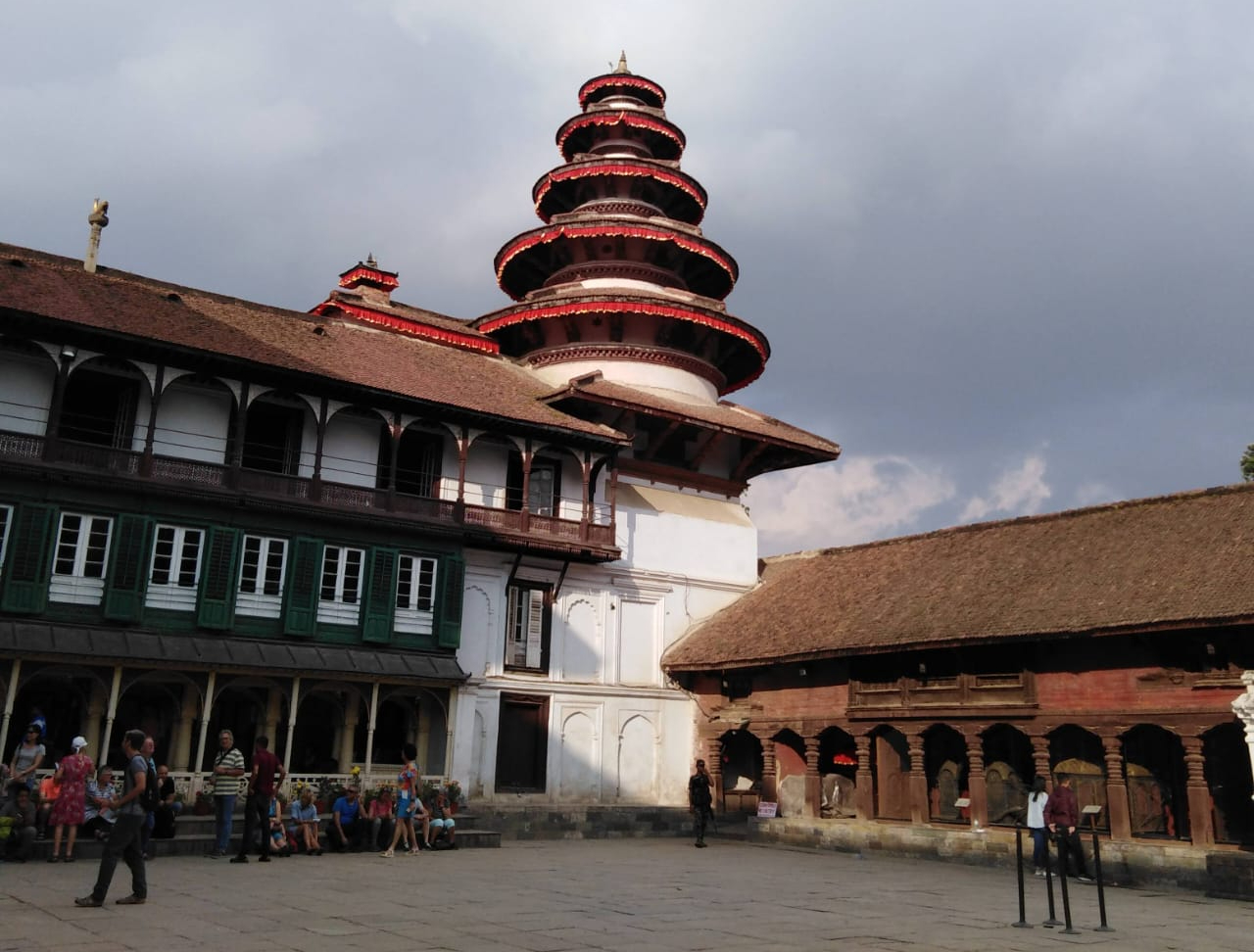

Comment